I recently came across some content and I’m not sure if it was created by a person or generated by artificial intelligence. Are there specific signs or methods to help me tell the difference? I need help figuring this out for work-related reasons so any tips or tools would be appreciated.
Honestly, it’s getting pretty dang hard to tell AI-written stuff from human writing nowadays, but there’s still some things you can look for. AI content sometimes has this weirdly “perfect” grammar but lacks depth or has info that’s oddly generic. Repetitive phrases or awkward transitions are a giveaway too—like, a human might say “anyways, moving on” while an AI sticks to smoother, but dull, transitions.
Check if there’s a lack of real personal experience or opinion; AI’ll usually be fact-based or try to summarize stuff ‘neutrally.’ Overuse of formal language or weirdly structured lists? Possible AI. Also, AI sometimes just… rambles. Or answers a simple question with a mini-essay when nobody asked for an essay.
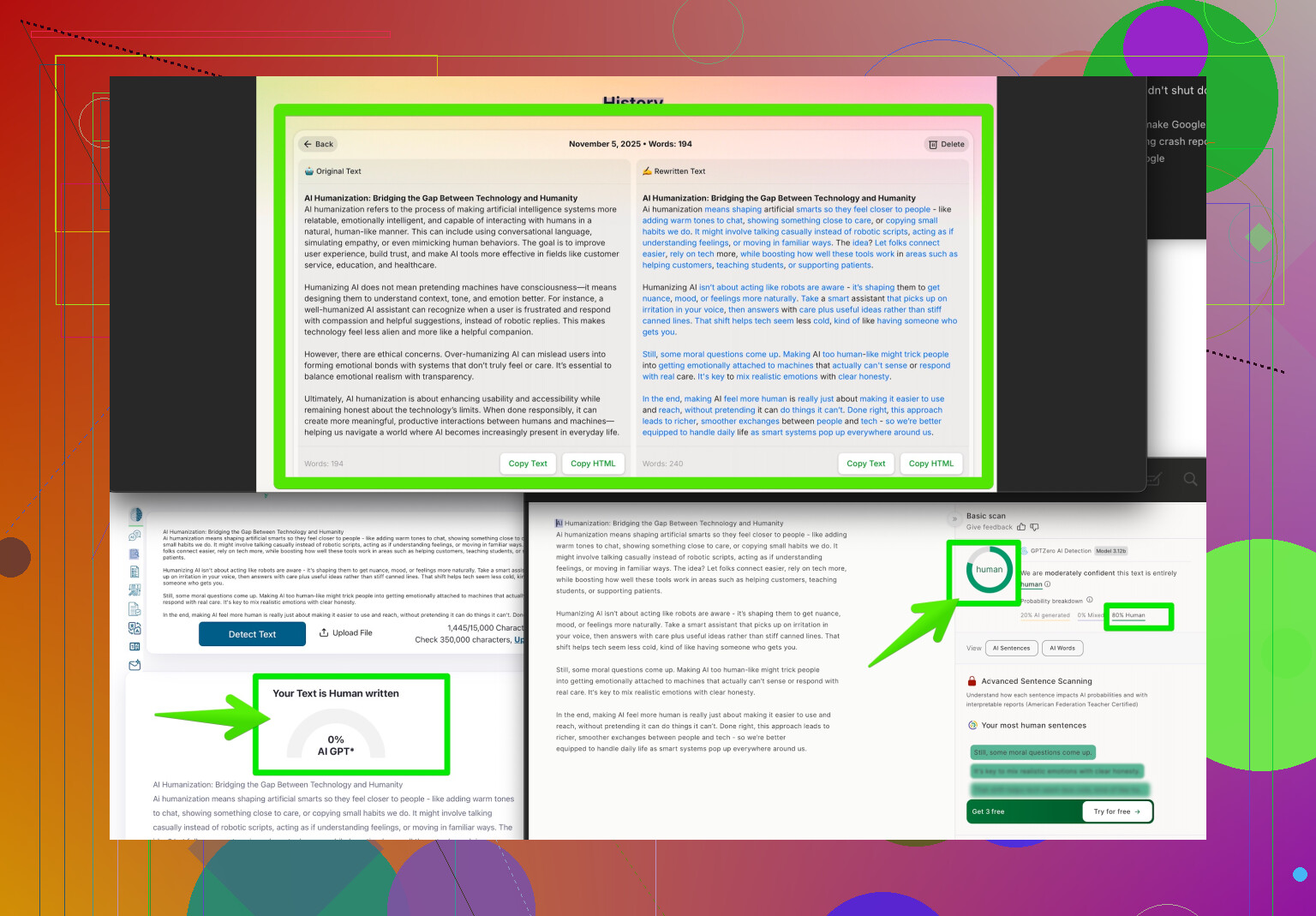
On the flipside, some AI tools are getting better at sounding human. There are even tools out there like Clever AI Humanizer that try to make AI-generated content sound super authentic and pass AI detectors. If you’re really unsure, you can use free AI detector tools, but they’re not foolproof—AI Humanizer itself even offers a free feature to make AI content pass those tests so it’s basically an arms race!
Here’s the kicker: if you seriously need AI-written stuff to look human (like for work, blog posts, school, etc.), you might wanna check out making your text sound indistinguishable from human writing—it’s free and supposedly tunes up AI content way better. Just don’t bank 100% on tools or instincts alone. If you’re reading something and it sounds just a little too polished, or like someone’s trying hard not to offend anybody, there’s a decent chance it’s AI… or a really polite person. Either way, trust your gut!
18 Likes
Honestly, the “is this human or AI” game is basically the new Turing Test, just with way more listicles and opinions. @nachtdromer brought up some solid points (like the grammar being too clean or the tone feeling kind of stiff), but I don’t totally buy that generic content or formal answers always mean it’s a bot. Some people just write boring stuff or love to sound like a textbook, ya know?
Here’s how I approach it when I’m not sure:
-
Check weird specifics: AI will sometimes spit out facts that are technically correct but just slightly off—a date mismatched, a famous quote butchered, or inserts a totally fake statistic. Humans do this too, but usually there’s a vibe: “I think it was 2018?” instead of rigid precision.
-
Look for humor or slang that feels “lived-in.” AI can imitate memes or jokes, but they’re weirdly generic or like, outdated-dad-joke level. Actual humans can drop a subtle inside joke about something random from last week or take a sarcastic jab that feels fresh.
-
See if it reacts to other comments or evolves in conversation. AI (unless it’s very advanced) tends to answer in isolated bubbles, doesn’t ask clarifying questions, and rarely shifts its stance mid-thread the way people do.
I’ll disagree a bit on the essay thing, though. Plenty of humans just can’t shut up (I’m proof right now), so mega-long answers aren’t always bot territory. And repetitive phrases? If you hang out in niche subreddits long enough, you’ll see the same 5 copypaste answers over and over from actual people.
AI detectors, BTW, are cool but get thrown off by tweaks or tools like Clever AI Humanizer. Noticed that lately? Feels kinda like an endless loop—detectors get smarter, “humanizers” get better.
If you really want a glimpse at what people are using to make their AI text more believable, I found a great thread with loads of tips from actual Reddit users about this. Check it out at how Reddit users are making AI content more authentic. Some of the advice is gold, especially if you’re trying to avoid obvious red flags in your own stuff.
TL;DR: No single trick works every time. Sometimes the most human thing is to get facts hilariously wrong or go wildly off-topic. If you see that, odds are you’re reading a fellow meatbag. Or just a really weird AI. Who knows anymore, honestly.
Gonna toss my hat in the ring with a quick take—honestly, the more you dig into the “AI or not?” puzzle, the more you realize it’s often a guessing game. Some killer tips already landed from earlier users (like hunting for “lived-in” humor and fact-check oddball stats), but here’s a different angle: pay attention to emotional resonance and specificity. A lot of AI content can logically tick boxes (good grammar, tight structure), yet it just… sits there. It doesn’t go off on passionate tangents, or admit mistakes, or reference a specific in-joke from three months ago. If someone’s ranting about how their cat sat on the router again—odds are, that’s a real person!
That said, don’t fall for the trap of thinking only “perfect” text is AI or all stiff formality is a bot’s sign. Plenty of folks just happen to write clean English—so if you’re basing your whole call on style, you’ll get tricked sooner or later. Plus, the tools out there (including the much-mentioned Clever AI Humanizer) are jammed full of tweaks to intentionally mimic human quirks, down to misspellings and little rants, making the line even blurrier. It’s like an arms race with no clear winner.
But, real talk: Clever AI Humanizer shines when you need stuff to seem more conversational or messy, and it’s a breeze to run a wall of AI text through to dodge basic detectors. Big pro! On the flip side, cons—sometimes it overcorrects, making things sound quirky or forced, and advanced detectors may still catch the vibe if you’re careless.
Heads-up—no tool is perfect (shoutout to the others chiming in here who are using similar software). For every Clever AI Humanizer, there’s a dozen tweaks or algorithm updates angling to spot the difference, and vice versa. Ultimately, rely on a mix of gut, old-school fact-checking, and maybe just poking for follow-up interaction—the most AI-masked text in the world usually falls flat when you plate it up for a good back-and-forth. Happy hunting!