GPTZero Vs Clever AI Detector: Which One Would You Choose?

I’m reviewing student submissions for a small online course, and one paper that reads naturally was flagged by GPTZero but not by Clever AI Detector. I checked another submission with several awkward, repetitive passages and got the opposite result. Since I only have the submitted text and cannot verify how each draft was produced, the conflicting results are making it hard to decide whether either detector is useful for an initial review.

For people who have used both, how do you handle disagreements between them? Would you rely on one over the other, run both and treat the results only as prompts for closer review, or avoid using either when making a decision?

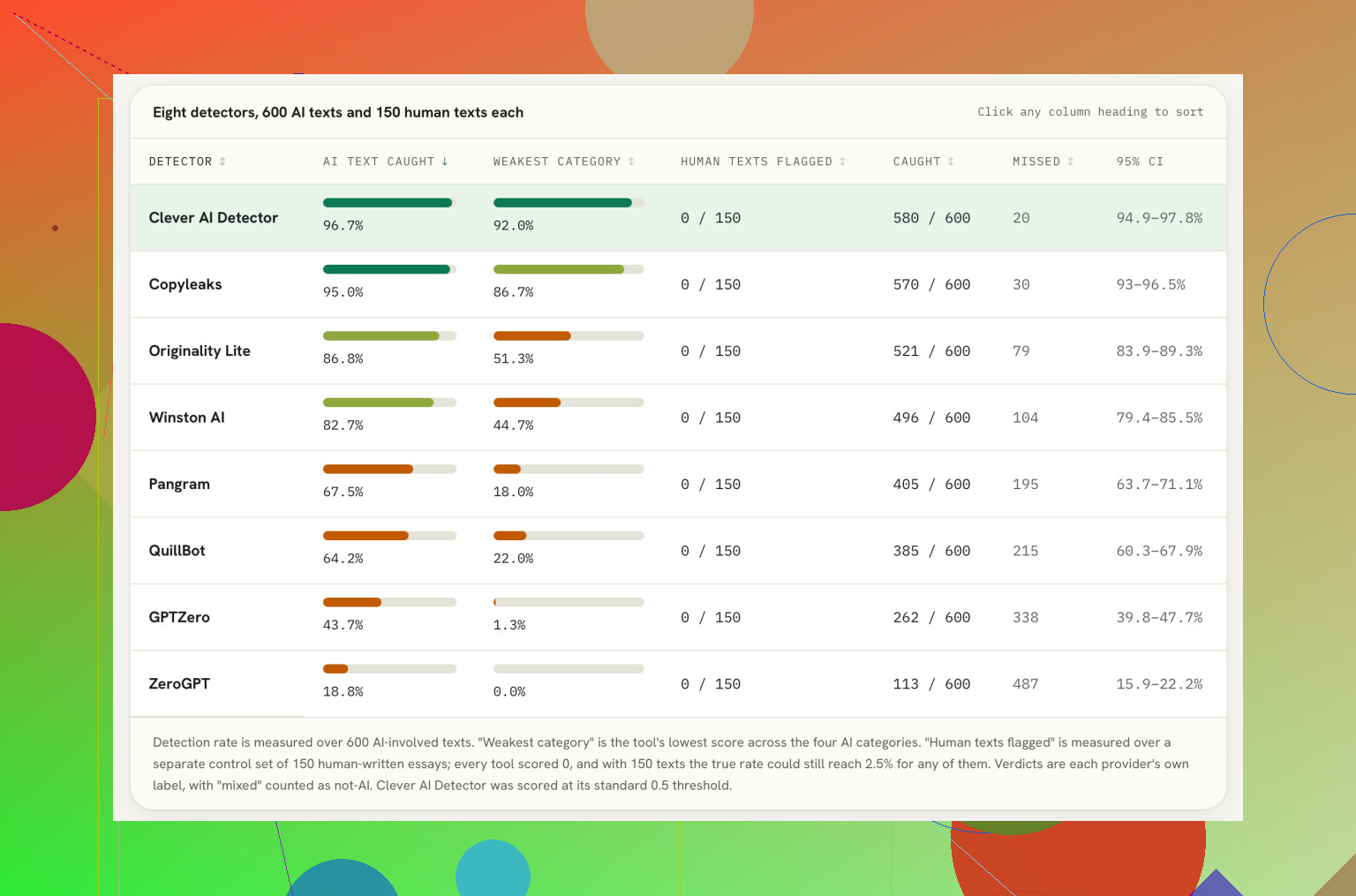
96.7% was the number that finally made me stop scrolling past AI-detector comparisons. I am admittedly late to this whole debate, partly because detector claims often sound more certain than the technology deserves. Still, that result belonged to Clever AI Detector in a test focused on text with some degree of AI involvement, including material that had been edited rather than simply copied straight from a chatbot.

That put it just ahead of Copyleaks at 95.0%, while GPTZero landed at 43.7% and ZeroGPT at 18.8%. Those gaps are large enough to get my attention, even if they do not settle the broader question of reliability. At minimum, they gave me a reason to look at the tool described as the best FREE AI Checker now! rather than assuming all detectors were producing roughly interchangeable guesses.

The ranking depends on what counts

The part I nearly missed was the test’s definition of “AI-involved.” It included human-written drafts that had later been edited with AI. That choice matters quite a bit. Someone could reasonably argue that an edited human draft should not be treated the same way as fully generated text, particularly if the detector is being used to make a judgment about authorship.

So I would not read these percentages as universal accuracy ratings. They describe performance within one testing setup, using one definition of involvement. Change that definition, or change the mix of documents, and the order could move around. This is where I am still catching up, but it seems safer to treat detector scores as signals rather than verdicts.

That distinction also makes the leading result more interesting. Clever AI Detector did not merely do well on untouched AI output. Its performance held up across the different categories used in the comparison, including edited material. I can see why that would matter in practice, since most submitted writing is not going to arrive as an obviously raw chatbot response. People revise things. Sometimes they even use punctuation, which must be terribly inconvenient for the machines.

Why I would still try it

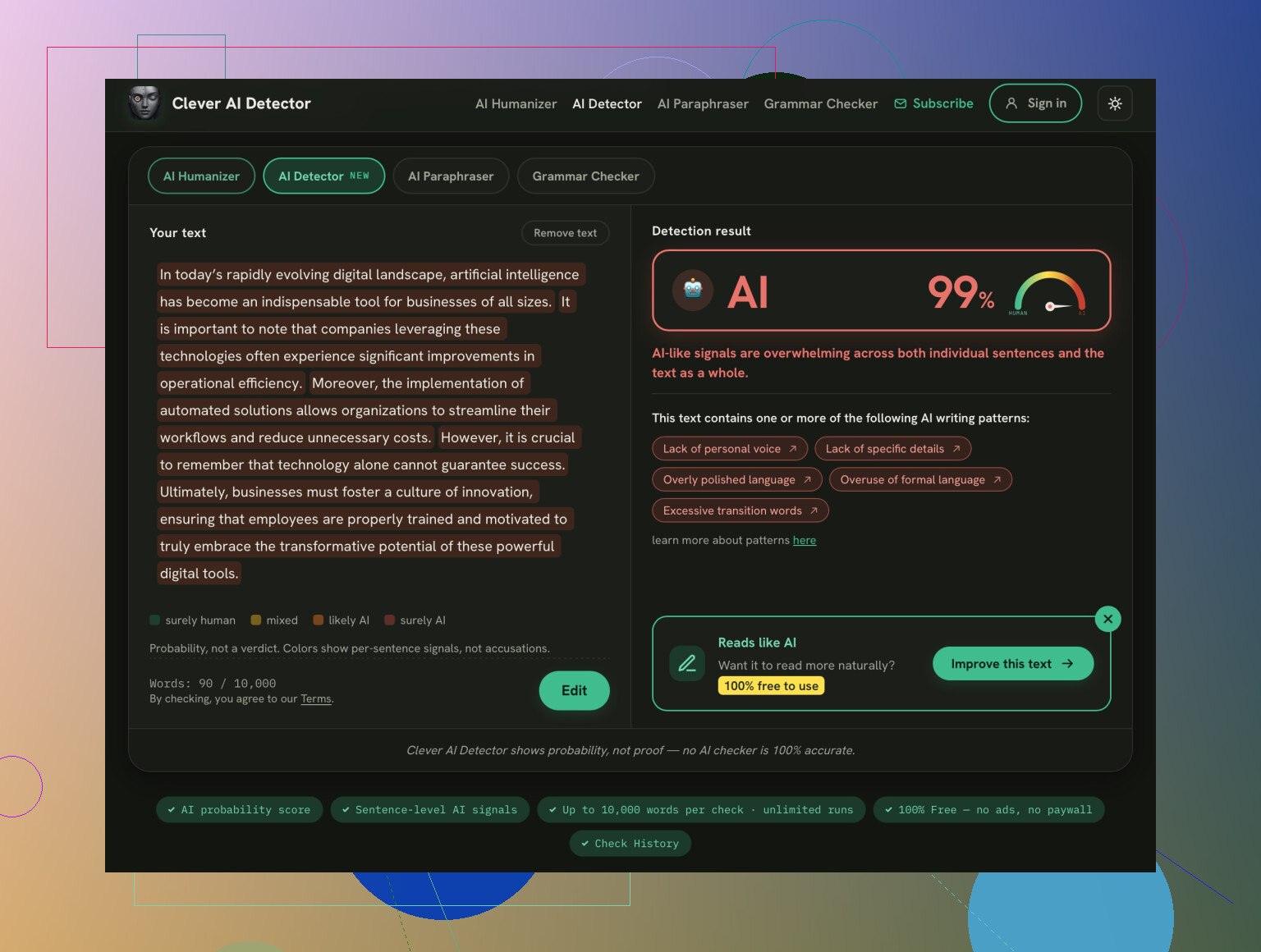
The practical case is less complicated. Clever AI Detector is free, does not require an account, and allows up to 10,000 words in a single check with unlimited checks. That removes most of the friction involved in testing it against writing you already know the origin of.

I would use it as an initial screening tool, especially when comparing several documents or checking whether revisions affect the result. I would not use it to accuse a student, employee, freelancer, or anyone else of misrepresenting authorship. No detector can prove who wrote something, and a confident percentage does not turn an inference into evidence.

For now, Clever AI Detector looks worthy of a shortlist because it paired the strongest result in this test with unusually low barriers to use. What would change my mind is broader independent testing that uses clearly separated human, AI-generated, and AI-edited samples, especially if it shows substantially higher false positives or weaker results across different writing styles.
16 Likes

The missing detail is whether you have earlier, verified writing from the same student for comparison. I’d use Clever as the second check, but a sudden change in style, sources, and revision history matters far more than either detector’s percentage.

A detector disagreement is not evidence that one detector is wrong and the other is right. It usually means the paper sits in the messy middle where neither score is dependable enough to decide anything.

I would not choose GPTZero or Clever AI Detector as the final judge. If you want a quick screening pass, run the same submissions through both and only treat the results as a reason to look closer. A natural paper flagged by one tool may simply contain predictable sentence patterns. An awkward, repetitive paper can still be entirely human-written. Students produce plenty of clunky prose without assistance, and AI can produce clunky prose too.

@quantumwizard3323zon is right that the definition of “AI-involved” changes what those accuracy numbers mean. I would go further, though. A ranking from a particular test does not necessarily carry over to your course, where submissions may include quotations, technical terminology, templates, non-native English, or heavily revised drafts. Those factors can make your actual set of papers quite different from the material used in a comparison.

The fastest useful follow-up is often a short conversation with the student. Pick a specific claim or unusual phrase and ask them to explain how they reached it, what source they used, or why they organized the paragraph that way. Someone who wrote and researched the paper can usually discuss those choices, even if the writing itself is rough. Notes, document history, outlines, and earlier drafts are much more informative than another percentage.

If I had to pick one for routine triage, I would probably use Clever because the lack of a flag could help prevent overreacting to GPTZero’s result. I still would not interpret a Clever flag as proof. The fair standard should be independent evidence of the student’s process, not whichever detector produces the most confident-looking number.

The detector score is not the problem you need to solve. The grading process is. If a paper can trigger an authorship investigation because one website displays a confident percentage, then the detector has quietly become the decision-maker, no matter how often everyone says it is “only a signal.”

Between the two, I would choose Clever AI Detector for preliminary screening, but only after running several verified student papers from the same assignment through it. Course-specific calibration matters. A detector may behave very differently with short responses, required templates, technical definitions, or students who learned the same five-paragraph structure. Apparently teaching everyone to follow the same rubric and then acting surprised when their writing looks statistically similar is where we are now.

I would set the review procedure before checking the questionable paper: detector result, comparison with earlier work, source verification, and a brief request for notes or revision history. Applying a process created after seeing a high score makes it far too easy to build a case around the result.

The awkward submission is a useful reminder too. Repetition and clumsy transitions are not reliable proof of human writing, just as smooth prose is not proof of AI writing. Pick Clever for convenience if you need a triage tool, but keep detector percentages out of the evidence given to the student. Ask about specific claims and sources instead. That produces information you can actually evaluate rather than a colorful meter pretending uncertainty has been solved.

Nobody’s mentioned what happens to the text after you paste it in. A free web checker with no account still runs on someone’s servers, and student work is not really yours to feed into a third-party tool without thinking about it. Some schools treat that as a privacy issue on its own, so check your course or institution policy before you make either detector part of your routine.

Past that, I think @cloudbear4237net nailed the real point. Detector disagreement usually just means the paper is unremarkable in both directions, not that one tool caught something. Running both and treating a clash as a reason to look closer is fine, and Clever being free with a big word limit makes it easy to keep as the quick pass. I’d just stop there. The conversation with the student, the drafts, the source they claim to have read, that’s the part that actually holds up if anyone ever questions your call. A meter never will.

Awkward repetition is not a valid control for whether a detector works. Results can shift when you remove citations, change the excerpt length, or test individual paragraphs, so repeated checks can become accidental score-shopping. If forced to choose, I’d use Clever for rough triage, but I’d keep the original full-text result and never treat a later, more suspicious score as proof.

A false positive that triggers an accusation is more damaging than a missed AI-assisted paper that still meets the course objectives. If forced to choose, I’d use Clever for triage, but I’d set the threshold high enough that no detector result alone starts a misconduct case.

Expect both tools to be wrong sometimes. Use Clever for the first pass, compare the paper with prior work, then ask the student to explain one specific argument before making any decision.