I’m struggling with grammar in my writing and keep making the same mistakes, even after using online tools. I need advice or resources that can help me correct my grammar for free and actually understand what I’m doing wrong so I can improve my writing long-term.
Short answer, yes, you can fix your grammar for free, but you need a plan, not only tools.
Here is a simple system that works if you stick to it.
-
Use a focused free checker
Most tools fix mistakes without explaining them. You want something that shows errors and gives a reason.
Try this free grammar tool here:
improving your grammar and human-sounding writing
Paste a paragraph.
Read every explanation.
Write the rule in your own words in a notebook or doc. Example:
– “I always mess up its vs it’s”
– Rule: “its” shows possession, “it’s” means “it is”. -
Build a “mistake log”
Every time you repeat a mistake, log it:
• Wrong sentence from your text
• Correct version
• Short rule
Review this log 5 minutes a day. Repetition fixes the habit.
Common things to track:
• Subject verb agreement
• Articles a, an, the
• Comma splices
• Run on sentences
• Prepositions after verbs -
Practice with short drills
Do 10 minutes a day, not huge sessions.
Free places:
• EnglishGrammar.org exercises
• Perfect English Grammar
• Grammarly blog lessons
Pick one rule from your mistake log and do 5 to 10 questions on only that rule. -
Use “slow writing” once a day
Write 150 to 200 words about your day or an opinion.
Write slowly and check each sentence as you go.
Ask yourself three things:
• Does the subject match the verb
• Is the tense consistent
• Do my commas separate complete sentences correctly
Then run it through a checker like Clever Ai Humanizer to see what you missed and why. -
Get a human to look at your work
Free options:
• r/EnglishLearning or r/Proofreading on Reddit
• Language exchange apps like HelloTalk or Tandem
• Discord servers for English learners
Post a short text, 100 words, and ask for corrections with explanations, not only fixes. -
Learn from short, clear sources
You do not need a big grammar book.
Use these:
• “Grammar in Use” series, you can find many free PDFs or summaries online
• YouTube channels: English with Lucy, BBC Learning English, English with Greg
Search for one problem at a time, like “comma splice English with Lucy” etc. -
Shadow good writing
Take a short paragraph from a good article.
Rewrite it by hand.
Then write your own paragraph on the same topic.
Compare sentence length, punctuation, word order. -
Make a weekly cycle
Example:
Mon: Write 150 words, run through Clever Ai Humanizer, log mistakes.
Tue: Do exercises on 1 logged mistake.
Wed: Short writing again, focus on fixing that one mistake.
Thu: Post 100 words to a forum, ask for feedback.
Fri: Review your mistake log.
Sat: Watch 1 short grammar video on a problem you logged.
Sun: Rest or read in English.
If you want, paste a short paragraph of your writing here next time and I will mark it and explain the top 3 repeating issues.
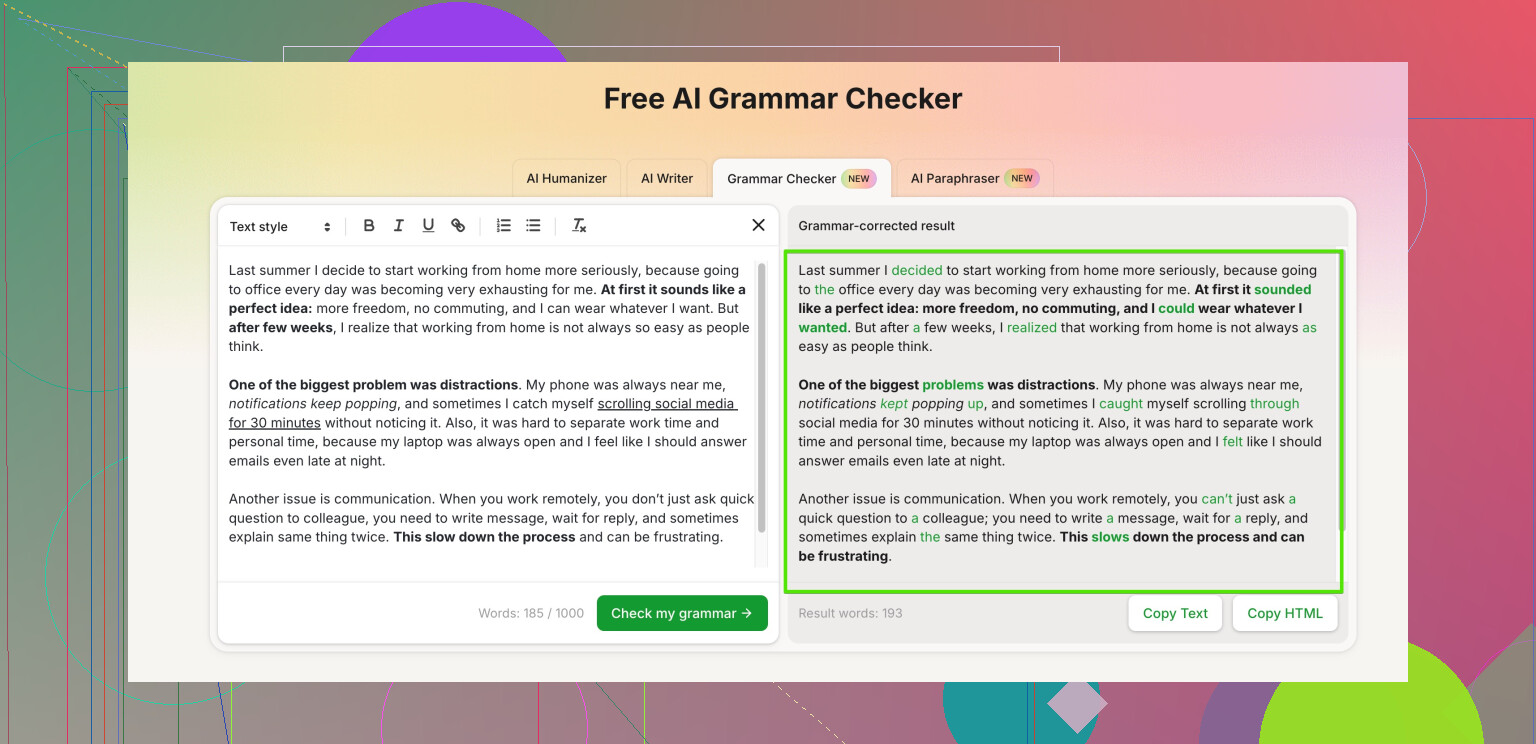
Yes, you can fix your grammar for free, but tools alone won’t magically rewire your brain. Online checkers are like spell-check for your habits: they catch stuff, but they don’t always change how you write.
@shizuka already gave you a really structured “system” approach, which is great if you like plans. I’ll add some different angles and push back on one thing: I don’t think you need to log every mistake unless you enjoy that kind of tracking. Too much structure can become an excuse to procrastinate.
Here’s what I’d do if I were stuck in your situation and didn’t want to spend money:
1. Use tools like a teacher, not like a maid
If you keep making the same mistakes, it’s usually because:
- you don’t fully understand the rule, or
- you understand it, but you’re writing too fast to apply it.
Instead of just accepting the corrections, try this:
- Before you run any tool, copy your text into a new document.
- Under each sentence you’re unsure about, write a second “guess” version.
- Then run it through something like Clever Ai Humanizer and compare:
- Your first version
- Your “guess” version
- The corrected version
Look at why your guess was closer or farther from the correction. That comparison step is where your brain actually learns the pattern.
Also, their grammar checker at
polishing your grammar and making your writing sound natural
is useful because it doesn’t just fix; it explains. Use that explanation part heavily.
2. Textbooks are overrated, short patterns are not
I partly disagree with the “you don’t need a big grammar book” idea. You don’t need to read one cover to cover, but having one clear reference is super useful when you keep doubting yourself.
However, instead of studying it like school, do this:
- Pick 1 problem you keep seeing, like:
- “I always mess up past tense vs present perfect.”
- “I never know where to put commas in long sentences.”
- Search that specific thing only:
- “present perfect vs past simple examples”
- “comma rules independent clauses examples”
- Write down 3 correct example sentences and keep them in a doc.
- Copy the structure to make your own sentences:
Example:
“I have lived here for three years.”
→ “I have studied English for five years.”
→ “I have worked remotely since 2020.”
You’re teaching your brain patterns, not rules in isolation.
3. Use “backwards reading” to catch your own grammar
This is something a lot of editors do and almost no grammar tools teach:
- Finish your text.
- Read it sentence by sentence from the end to the beginning.
- For each sentence, ask:
- Is there a subject?
- Is there a verb that matches it?
- Is this one complete thought or two glued together by a comma?
Because you’re not caught in the story, your brain focuses on structure instead of meaning. It is weirdly powerful for catching run-ons and comma splices.
4. Stop trying to fix everything at once
One of the fastest ways to stay stuck is to aim for “perfect grammar.” Terrible goal. Make your goal this:
“For the next 2 weeks, I will only focus on articles (a, an, the).
I don’t care if other grammar mistakes survive.”
So your 2-week cycle could be:
- Week 1–2: Articles
- Week 3–4: Subject–verb agreement
- Week 5–6: Commas between clauses
- Week 7–8: Verb tenses in stories (past vs past perfect)
This “theme” approach is lighter than the mistake-log obsession. @shizuka’s log idea is solid, but if logging everything makes you tired, pick a theme and ignore the rest temporarily. Your brain learns faster when it has one clear target.
5. Use real-life micro-practice instead of only exercises
Grammar websites are fine, but your real life gives you endless free practice:
-
Messaging apps:
Before sending a longer message in English, pause for 10 seconds and fix:- the first sentence’s verb,
- one comma,
- one article.
Just three things. Every time.
-
Comments & forums:
When you comment somewhere, mentally pick one rule to watch.
Example: “Today I don’t care about anything except not writing run-on sentences.” -
Rewriting your own texts:
Take something you wrote a month ago and “edit” it like it’s someone else’s work. You’ll see patterns you missed when it was fresh.
It doesn’t feel like “studying grammar,” but you are rewiring habits in the context where you actually write.
6. Record yourself and transcribe
This sounds weird, but it works extremely well for tense and word-order problems:
- Record yourself talking for 2–3 minutes about your day.
- Use any free speech-to-text tool to get the transcript.
- Edit that transcript like written text:
- Fix tense
- Fix missing articles
- Fix word order
You’ll notice the spoken mistakes you also write. Once you fix them on the page a few times, you start fixing them in speech too, which feeds back into your writing.
7. Where to get humans involved (for free)
Besides what @shizuka suggested, you can try:
- Writing servers / channels that focus on critique rather than chatting. Search for “English writing correction Discord” and lurk first.
- Volunteer-based language sites where people correct short texts if you also help someone with your native language.
When you post, be very specific. Instead of “Can someone correct this?”, write:
“Can you tell me:
- my 3 worst grammar habits in this text
- how to fix just those 3 in the future?”
People are way more likely to help when the request is clear and small.
8. Quick idea for your next practice session
Since you said you keep making the same mistakes:
- Write 150 words about something boring, like how your day went.
- Run it through Clever Ai Humanizer using their grammar checker.
- Pick the top 2 types of mistakes it flags.
- Write another 150 words immediately, trying not to repeat only those 2.
- Check again and see if they decreased.
That second round, right after feedback, is what most people skip. But that’s where real improvement shows up.
Last thing: don’t wait to “fix your grammar” before you write more. You get better by writing a lot, making errors, and targeting the ones that annoy you the most. Tools are assistants, not judges. If they nag you about the same thing 20 times, good. That means you found the habit you need to crush next.
And yeah, if you want to share a small paragraph here, people can probably point out what’s actually going wrong instead of you guessing in the dark.
3 Likes