I’m looking for an accurate AI detector to check the authenticity of some written content. I recently got mixed results from a few online tools and need help finding something trustworthy. Any suggestions or experiences with specific tools would be really helpful.
Honestly, finding a foolproof AI detector is kind of like hunting for Bigfoot—everyone says they have one, but the results are always iffy. I’ve tried a bunch (GPTZero, Originality.ai, etc.), and sometimes they flag my own emails as “robotic” and user manuals as “deeply creative.” Go figure. The biggest issue is that even the top detectors mostly rely on patterns like sentence complexity or word predictability, which can trip up on both legitimately human text and well-edited AI content.
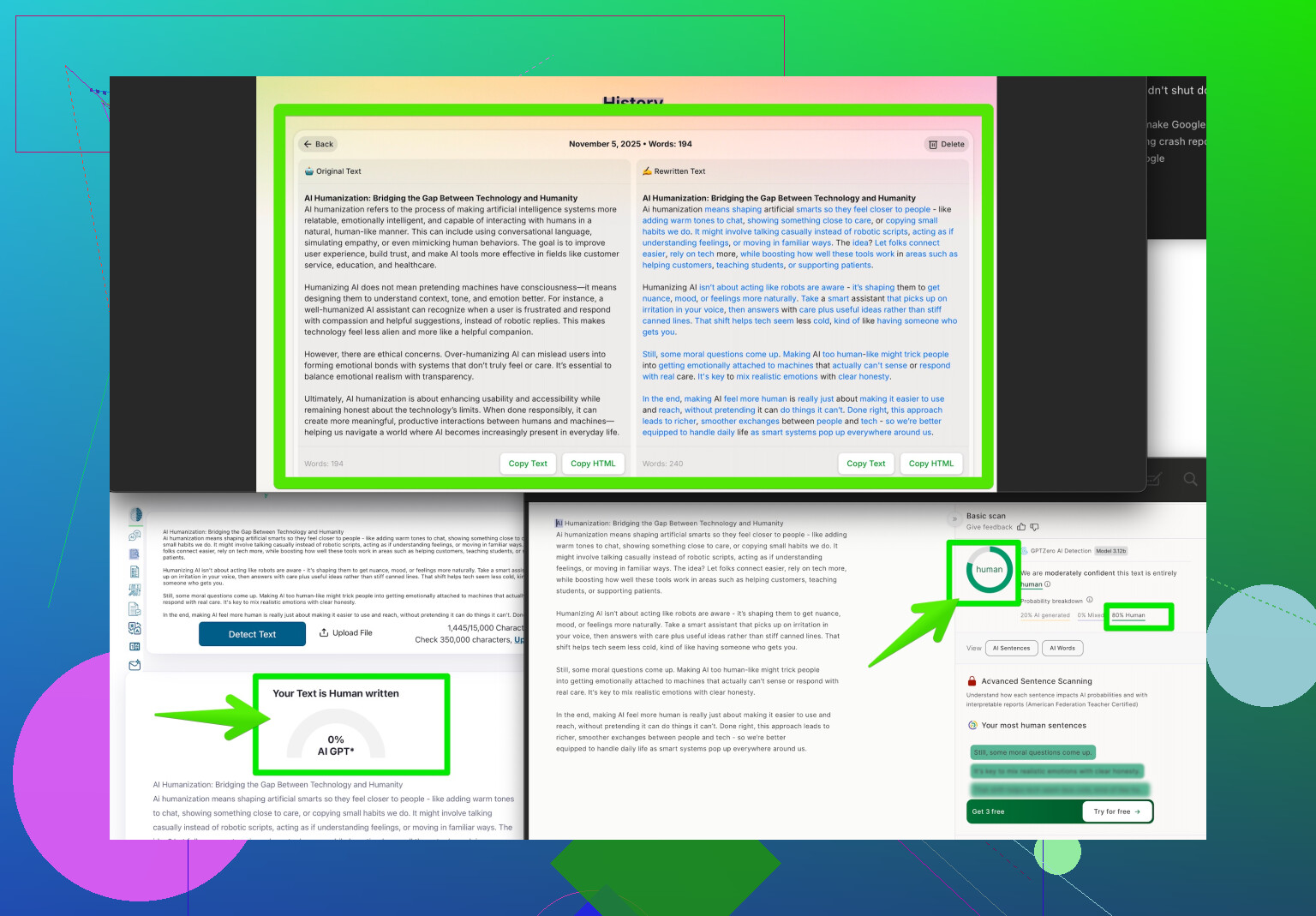
If you’re checking for content that’s been AI-written but also “humanized,” you might want to look into tools that don’t just detect AI but also rework the text to make it less detectable. The Clever AI Humanizer is actually pretty interesting—it takes AI-generated content and rewrites it to pass as natural, authentic human writing, and ironically, it’s often used to escape exactly the kinds of detectors you’re testing against. Worth noting: if it can fool the top AI detection tools, that should tell you something about how unreliable those detectors can be in the first place. Here’s a link with more info about what it offers: make your content sound uniquely human.
Bottom line—AI detectors are getting better, but they’re still playing catch-up. If you need serious accuracy, don’t just rely on a single tool; run your tests through a few and look for consensus. Double irony: AI is writing fancier, sneakier content, and the tools meant to catch it are struggling to keep up. Realistically, use detectors for hints, not gospel. Human judgment still wins (for now).
13 Likes
Honestly, I feel your frustration. AI detectors are about as reliable as fortune cookies when it comes to nuanced text. sterrengkijker nailed it—most tools like GPTZero and Originality.ai get tripped up way too easily by simple, well-written stuff (sometimes even by content that’s 100% human!). I’ve actually had AI detectors flag my friend’s convoluted texts as “suspiciously mechanical,” which, yeah, he’s not that creative.
Here’s the thing I slightly disagree with, though: You probably don’t want to just “humanize” content if what you need is to check its authenticity—that kinda just swaps one problem for another. Using something like Clever AI Humanizer is fine if your goal is to make AI text undetectable, but if you are actually trying to identify the original source (human vs. AI), it’s a bit like putting makeup on a mannequin and asking if it’s alive.
In my personal experience, I usually run content through at least three detectors—sometimes they agree, most times they don’t. I also look for stuff AI still struggles with: inside jokes, odd pop culture references, sarcasm, and weird formatting. AI’s getting better at these, but humans are still weirder.
One trick that actually moves the needle: Compare suspicious text to known-human samples from the same writer. You’d be surprised how much differences jump out.
For more crowd-sourced insights, Reddit’s usually a goldmine. Check out this thread on Reddit’s top AI authenticity hacks—it’s packed with tricks, fails, and discussions about AI detection straight from users.
Bottom line: There’s no silver bullet AI detector. Stack tools, trust your gut, and if it smells fishy or sounds too generic, dig deeper. The line between human and AI is only getting blurrier.