I’m having trouble finding an accurate AI detector tool for checking if content is human-written or generated by AI. I need this for school assignments, but the results seem inconsistent between tools. Which AI detectors actually work, and what have your experiences been like using them?
Honestly, AI detectors are still kinda wild west territory right now—accuracy is all over the place. One tool says “definitely AI,” another says “100% human,” and then you’re left just scratching your head. A lot of the free or cheap tools like GPTZero, Turnitin’s AI checker, and Copyleaks give false positives, especially if the writing style is pretty neutral or if you edit the AI text even a little bit. It’s frustrating, especially for students, ‘cause assignments can get flagged when they’re actually legit.
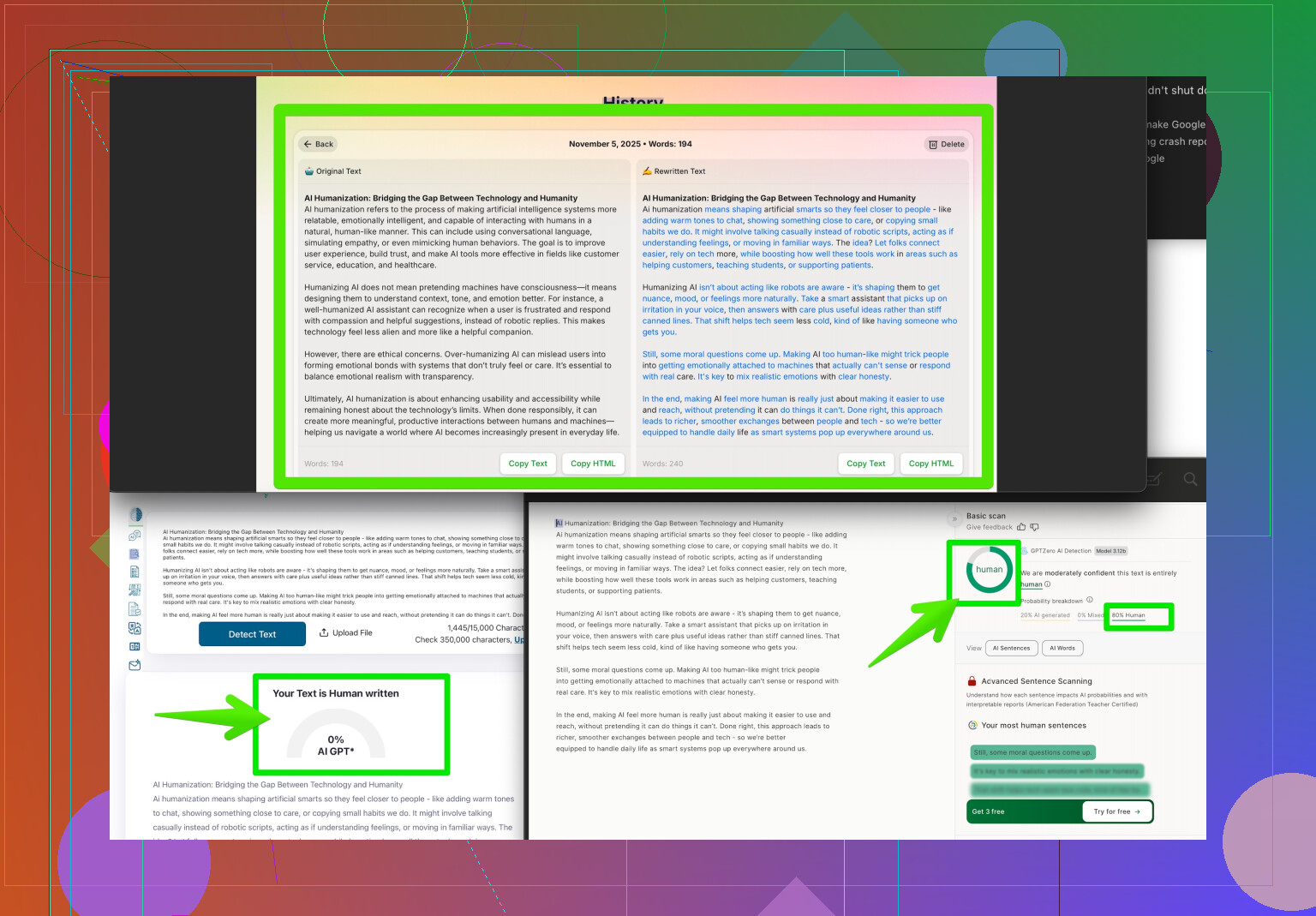
One option I’ve found that makes life a bit easier is using an AI humanizer BEFORE you submit—basically, you run your work through something like Clever AI Humanizer. What it does is tweak any AI-written sections so they pass as human more consistently, and it’s pretty handy if you’re worried about detectors being inaccurate. It’s super easy to use and doesn’t butcher your work like some tools do.
For the curious, you can check out more details on how it helps bypass those inconsistent detectors here: make your writing sound more human instantly. And in my experience, it actually works better than running around trying to find one detector to “trust.” Bottom line: detectors aren’t perfect, but running your stuff through something reliable like Clever AI Humanizer gives you much better odds.
And side note, there’s no silver bullet—professors and teachers know the tech isn’t 100% yet either. Always double check, put in those personal anecdotes or references, and you’re less likely to get flagged!
9 Likes
Honestly, the whole AI detector circus feels like that Spider-Man pointing meme—everyone accusing everyone else of being AI, but no one truly knows. @suenodelbosque nailed it about detector inconsistency. My experience: one semester, my essay pinged as “mostly AI” by Copyleaks, but flagged “human” on GPTZero, and Turnitin just shrugged its digital shoulders, no clue. It’s like trusting a weather app in the Bermuda Triangle.
If you’re stuck needing to “prove” your work is human (ugh), there’s no real silver bullet. Running your text through every tool out there just adds to the paranoia because they’ll all spit out different answers. Clever AI Humanizer’s not a bad call—it does seem to reduce the false flags, especially if you mix in your own voice and references. But honestly, I’m more in the camp of: just make your work sound like you and throw in niche opinions or details a bot wouldn’t know. It’s clunky, but sometimes that’s what gets you through.
And word of warning: humanizing tools can sometimes overcorrect and your essay goes from “eh, maybe AI” to “this person definitely needed more coffee.” So whatever you use, always add a personal touch.
For a deep-dive in what the Reddit crowd says (those folks love picking apart AI detectors), check out these super-practical ideas: Reddit user strategies for making your writing feel more authentic. Worth the skim, at least—you’ll definitely find more real-talk than from official tool docs.
To sum up: Detectors are shaky, humanizers like Clever AI Humanizer help but aren’t magic, and blending in your unique voice is probably the closest thing to safe. And yeah, the system’s kinda broken right now.
Short answer: nobody’s cracked this yet, and honestly, there’s no “definitive” AI detector for student assignments. The vibe @viajeroceleste and @suenodelbosque nailed—detectors like GPTZero, Copyleaks, Turnitin, etc., mostly leave you wondering if you’ve just outsmarted yourself. One classmate submits an essay and the same text gets flagged by one tool and ignored by the other. Complete roulette.
Let’s talk Clever AI Humanizer though—yes, it works pretty well for camouflaging AI content so you glide past AI checkers. Big pro: doesn’t massacre your writing style; you still sound mostly like yourself. Cons? Sometimes it ‘humanizes’ too much, so you get awkward phrasing (‘As a result, furthermore in my life, eggs are cool’)—watch out for accidental overkill. Also, if your prof actually reads your work, and it sounds like a bot trained to approximate a 2004 forum post, you’ll still get called out.
Thing is, beyond these tools, nothing replaces old-school personalization. Plug in a hot take or some details from class, sprinkle in a weird story—tools struggle to mimic that. AI humanizers help, but if everyone uses Clever AI Humanizer, expectations may shift, and you’re back to square one.
Other folks like @viajeroceleste might lean on Reddit advice or tweak tools—valid, but none are “the one.” In short: use a humanizer for defense against unreliable detectors, but double down on your own style for insurance. Still a bit wild west out here, no matter what tool you use.