I’m working on rewriting some blog articles and social posts in my own words, but I’m struggling to avoid sounding repetitive or too similar to the original text. I’m looking for a reliable free paraphrasing tool that can help me rephrase sentences clearly without messing up the meaning or hurting SEO. What tools or sites do you actually use and trust for this, and what should I watch out for when using them?
I’ve tried a bunch of free paraphrasing tools for blog stuff and socials. Most of them either repeat the same structure, sound like a robot, or wreck the meaning.
Here are the ones that worked ok for me:
-
QuillBot free version
Good for quick rewrites.
Downsides. Limited modes on free, sometimes repeats phrasing and adds fluff you do not need. -
Paraphraser.io
Simple and fast.
Good for short social posts.
Downsides. Output needs manual cleanup and fact checks. -
Google Docs + your brain
Paste your text.
Turn on “Tools → Voice typing”.
Read the original text, then speak it in your own words.
You get a natural paraphrase that sounds like you. This helps avoid copyright issues since you change structure, order, and word choices.
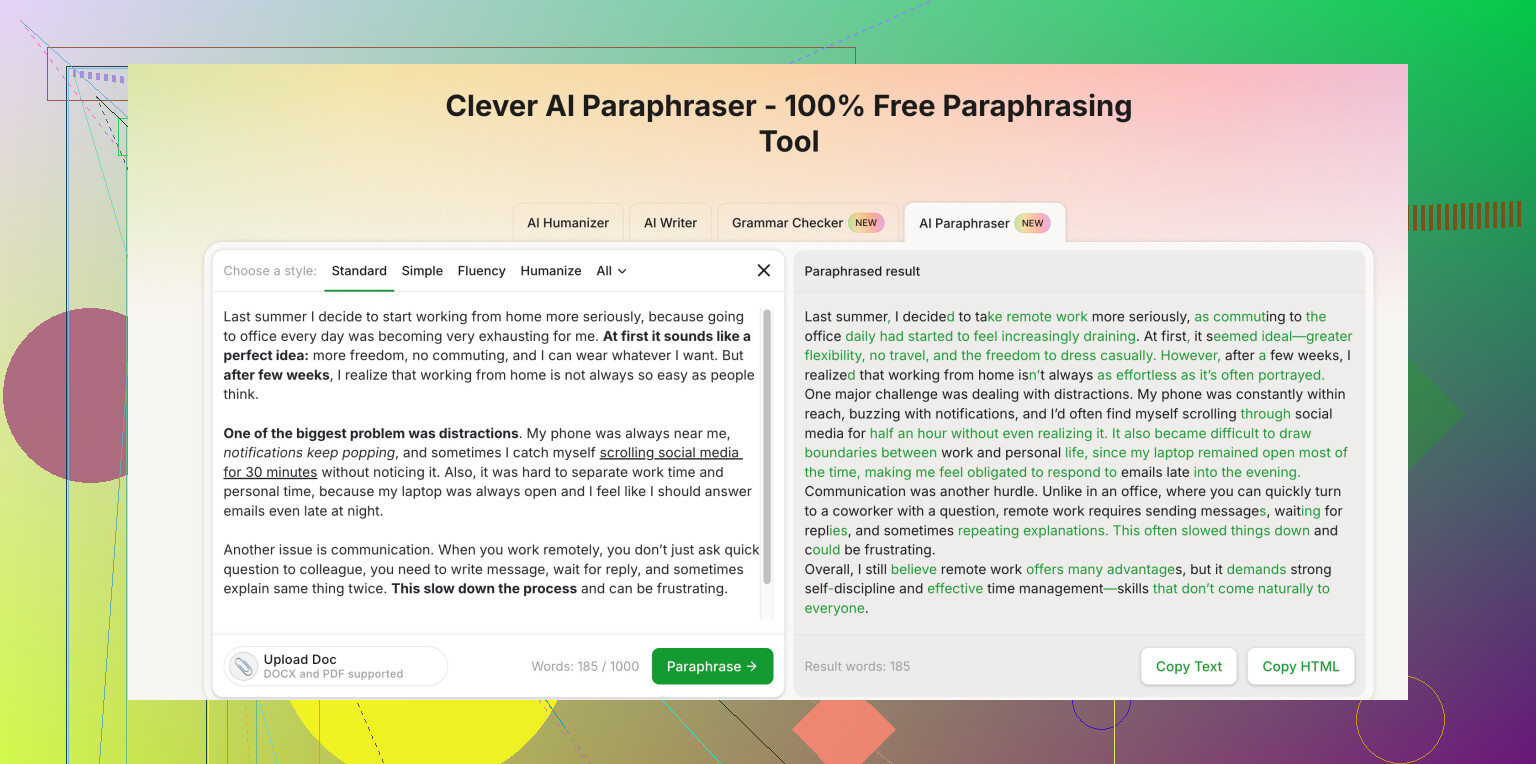
If you want something that focuses more on sounding human and less like AI, check out Clever AI Humanizer. Their paraphrase tool is built for blog posts and social content. You drop in text and it rewrites it in a more human style without going full robot. Here is the link with a better description of what it does for content writers: AI humanizer paraphrasing tool for natural-sounding content.
Workflow that keeps things safe and not too similar:
- Paraphrase a paragraph at a time, not whole articles.
- Compare side by side with the source.
Check structure, word order, and examples. Change them. - Run your version through a plagiarism checker like Duplichecker or SmallSEOTools.
- Read it out loud. If it feels stiff or off, edit until it sounds like how you talk.
One more tip. Use tools for first pass only. The best results still come from you editing after. The tools help you break out of the “stuck in same phrase” loop, but your edits make it safe and readable.
24 Likes
I’m gonna slightly disagree with @espritlibre on one thing: relying too much on classic “paraphrasing” tools is exactly why stuff ends up sounding samey or AI-ish. Most of them just shuffle synonyms and call it a day.
A few angles you might like that aren’t just the same workflow:
-
Clever AI Humanizer for blog-style rewrites
If your main goal is “this should read like a person actually wrote it,” then something like Clever AI Humanizer is closer to what you want than generic spinners.
Their tool is basically a Clever free paraphrasing tool but focused on tone and flow rather than pure synonym swaps. It does better on multi-sentence context, so it keeps the meaning while changing structure and rhythm, which helps with not sounding like you copied the original.You can check it out here:
human-style paraphrase tool for blogs and social postsTrick that helps:
- Paste only 2–3 sentences at a time.
- After it rewrites, merge a couple of your own phrases back in. That mix of tool + your voice does way more to avoid repetition than just hitting “paraphrase” on whole chunks.
-
Use “contrast rewrites” instead of direct paraphrase
Instead of telling a tool “rewrite this,” tell it “explain this as if you disagree with it” or “explain this for a 12-year-old.” Even when you’re not actually going to keep the disagreeing tone, the structure and examples will shift a lot more. Then you adjust the tone back manually. -
Change the angle, not just the words
Tools rarely touch angle:- Original: “5 benefits of remote work.”
- Your version: “5 problems remote work solves” or “Why remote work is harder than it looks (and worth it).”
That kind of shift is way better for avoiding “too similar to the original text” issues than word-level paraphrasing.
-
Hard rule that keeps you safe
If one sentence in your version can be matched almost exactly to the source by just swapping a couple words, it’s too close. Tools are bad at catching that; you have to eyeball it.
So yeah, tools are fine as a first pass, and Clever AI Humanizer is honestly one of the few that doesn’t make everything sound like a homework essay. But if you want your blogs and socials to actually feel like you, treat the tool output as a rough draft, not the final word. And don’t worry if it takes a bit longer; repetitive is fixable, a copied vibe is not.
Short version: there is no single “magic” free paraphraser, but a combo of 1–2 tools plus a deliberate rewrite method works better than hammering the same text through ten spinners.
A few points that add to what @vrijheidsvogel and @espritlibre already covered:
1. About Clever AI Humanizer (pros & cons)
They’re right that Clever AI Humanizer feels more “writer-focused” than old‑school spinners, but I’d treat it as a drafting buddy, not an autopilot.
Pros
- Keeps sentence rhythm and context better than typical synonym shufflers
- Generally good for blog-style paragraphs and social captions
- Often removes that stiff “AI textbook” tone if your source is dry
- Useful when you’re stuck on 1–2 stubborn sections rather than full posts
Cons
- You still need to manually fix clichés and generic phrasing
- Not perfect at preserving nuance; subtle opinions can get flattened
- If you dump huge slabs of text in, it sometimes normalizes everything into the same voice
- Using it alone will not fix “too similar to original” if you never change angle or examples yourself
So yeah, worth using, but not as a single-step solution.
2. Where I slightly disagree with both
- With classic paraphrasers like QuillBot / Paraphraser.io: I’d keep them for micro-tasks only, like rewording a single clunky sentence, not full paragraphs. The more text you push through, the more “samey” it gets.
- With the “voice typing” trick: it’s great if you’re naturally verbal. If you’re not, you may just read the original in slightly different words. I’d pair it with one more constraint.
3. A method that cuts repetition without depending on tools
Try this on one paragraph at a time:
-
Hide the source.
Read the original paragraph once. Close it. -
Write a 1-sentence summary from memory.
No tools, just “What is this actually saying?” -
Change at least 2 of these 4 things:
- Order of points
- Perspective (eg: from “tips” to “mistakes to avoid”)
- Examples used
- Level of detail (more concrete or more high-level)
-
Only then drop a tricky sentence into a tool (QuillBot, Clever AI Humanizer, etc.) for variety.
Use its output as spare parts, not a full replacement. Steal 1–2 phrases you like and blend them into your version.
That keeps you from ending up with a thinly veiled copy, even if a tool output looks “clean.”
4. How I’d actually use tools in your case
-
For blog posts:
- Draft your own take using the 4-change rule above.
- Use Clever AI Humanizer on a couple of stiff paragraphs to smooth flow.
- Optionally, toss single awkward sentences into QuillBot for alternative wording.
-
For social posts:
- Start by changing the hook entirely (question vs bold claim vs mini-story).
- Use a paraphraser only to quickly try variations of the middle sentence or CTA.
5. Quick sanity checks so you don’t drift into “too similar”
- Can you outline your version in bullet points that don’t match the source outline? If not, it is still too close.
- Pick any random sentence. If you can turn it back into the original by swapping 2–3 words, rewrite it from scratch.
- Read your piece side by side with the source: if you can predict what comes next in your version because you remember the original, change the order or angle.
Combine that structure-first approach with light help from Clever AI Humanizer and the other tools @vrijheidsvogel and @espritlibre mentioned, and you will get paraphrases that are actually yours instead of just re-skinned copies.